Lab Testing Language for Forage Additive Labels
Forage additive labels do not need softer wording. They need cleaner evidence trails.
If your plant is building a silage inoculant, enzyme-enhanced dry blend, liquid applicator product, or private-label additive, the label has to do more than read well. It has to connect formulation intent, lab screening, manufacturing controls, and field-facing instructions without creating unsupported claims.
That is where disciplined lab-testing language matters. It gives product managers, regulatory reviewers, distributors, and large forage customers the same answer: what the product is designed to do, where the enzyme fits, and how batch-to-batch performance is controlled.
Clampdown Forage Labs supports additive manufacturers that need a silage enzyme supplier for forage additive manufacturing with documentation-ready enzyme inputs, compatibility support, and formulation language that can survive commercial review.
Why label language fails in forage additives
Most weak labels fail for one of four reasons:
- The enzyme role is vague. The label says “improves fermentation” without explaining whether the enzyme supports fiber access, sugar release, viscosity reduction, or blend functionality.
- The claim is stronger than the data. Internal screening may support a controlled formulation benefit, but the label implies universal field performance across crop type, dry matter, chop length, and storage practice.
- Compatibility is assumed. Enzymes, lactic acid bacteria, carriers, minerals, acids, flow agents, and liquid tank conditions are treated as if they are neutral to one another.
- Manufacturing reality is missing. A label may read well at bench scale but ignore heat exposure, blend order, packaging moisture, warehouse duration, or applicator dilution.
A stronger label is not more complicated. It is more specific.
The practical language buyers expect
For a forage additive manufacturer, testing language should help answer these buyer-side questions:
- What forage conditions is the product designed around?
- What is the enzyme intended to support in the formulation?
- How is the product applied and at what inclusion level?
- What organisms, carriers, acids, preservatives, or nutrients are compatible with the enzyme system?
- What storage and handling limits protect the finished product?
- What documents can the manufacturer provide with each production lot?
When those answers are visible, the label supports procurement, technical sales, and QA instead of pushing all explanation into a follow-up call.
Use function-based enzyme descriptions
Avoid generic phrases that make every enzyme sound identical. Use function-based descriptions that are tied to forage processing and fermentation support.
Stronger wording examples
- “Enzyme system selected to support access to fermentable plant carbohydrates in chopped forage.”
- “Designed for use in inoculant blends where enzyme compatibility with selected lactic acid bacteria has been reviewed.”
- “Supports formulation strategies targeting improved substrate availability during early ensiling.”
- “Suitable for dry premix or liquid-use formats when handled under the storage and dilution guidance supplied by the manufacturer.”
Weaker wording to avoid
- “Guarantees faster fermentation in all silage.”
- “Breaks down all fiber.”
- “Works under any storage condition.”
- “Compatible with all inoculants and preservatives.”
Commercially direct language does not overpromise. It tells a technical buyer what was considered.
Separate label claims from specification-sheet details
The label should not carry the full burden of technical documentation. For many silage additive manufacturers, the cleanest structure is:
- Product label: intended use, application direction, storage guidance, safety handling, and concise functional positioning.
- Technical data sheet: formulation role, recommended inclusion range, compatibility notes, carrier guidance, and manufacturing handling recommendations.
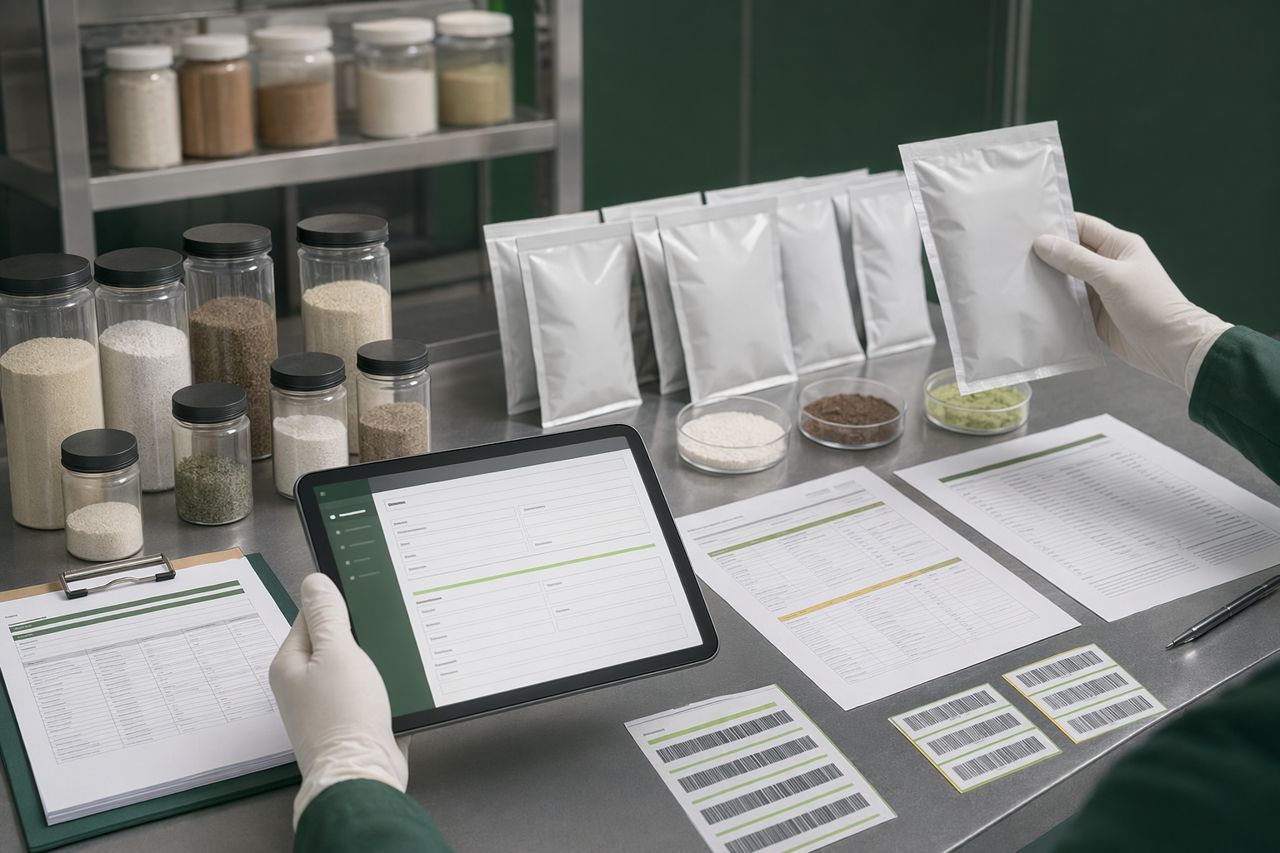
- Certificate of analysis: lot identity, physical characteristics, microbial quality status where applicable, moisture profile, and release confirmation.
- Stability statement: shelf-life position under defined packaging and storage conditions.
- Compatibility summary: status with the selected inoculant strains, carrier system, acids, preservatives, minerals, and liquid-use conditions.
This structure keeps the label readable while giving distributors and key accounts the documents they need to approve the product.
Write inclusion-rate language for manufacturing use
Inclusion-rate language should connect the enzyme input to the finished additive format. A product manager needs to know how the enzyme will be added to the blend, how it affects carrier loading, and whether it supports the application rate promised on the finished product.
Useful wording includes:
- “Formulated for inclusion into dry forage additive premixes according to the finished-product application target.”
- “Recommended inclusion level should be confirmed against carrier capacity, blend uniformity, and intended forage application rate.”
- “For liquid-use products, confirm dilution conditions, hold time, and tank compatibility before commercial release.”
- “Do not revise enzyme inclusion independently from inoculant count, carrier load, and package moisture targets.”
This is the difference between buying an ingredient and building a repeatable additive.
Compatibility language should be direct
Compatibility is one of the highest-value sections of a forage additive specification. Enzymes are frequently combined with lactic acid bacteria, sugars, minerals, organic acids, anti-caking agents, liquid carriers, preservatives, and colorants. Some combinations are routine. Others require screening.
Recommended label-adjacent wording:
- “Compatibility reviewed for the stated formulation matrix.”
- “Confirm performance when changing inoculant strain package, carrier source, acidifier, or liquid dilution practice.”
- “Avoid assuming equivalence between dry blend, soluble powder, and liquid-use systems.”
- “Revalidation is recommended after major supplier, carrier, packaging, or process changes.”
This wording is practical, not defensive. It protects the manufacturer from uncontrolled substitutions while giving the buyer confidence that the formulation has boundaries.
Stability language should match the actual supply chain
A stability statement is only useful if it reflects the way the additive is manufactured and sold. For silage additives, the relevant conditions are usually not just time and temperature. They include moisture exposure, packaging barrier, warehouse cycling, blend pH, carrier chemistry, and whether the product is held as a concentrate or diluted before use.
Clear stability language may include:
- “Shelf-life position applies to unopened packaging stored under dry, cool warehouse conditions.”
- “Finished blend stability depends on carrier selection, package barrier, moisture control, and exposure during processing.”
- “Liquid-use stability should be confirmed under the customer’s dilution and hold-time conditions.”
- “Repackaging or bulk transfer may require additional review.”
For a manufacturer, this language helps prevent the most common complaint pattern: the ingredient was stable, but the finished product system was not controlled.
Field-validated does not mean field-unlimited
Forage outcomes are affected by crop maturity, chop length, dry matter, packing density, oxygen exclusion, storage face management, and weather before harvest. A good additive label should not pretend those variables disappear.
Better wording:
- “Developed to support fermentation management when used with sound ensiling practice.”
- “Designed for chopped forage systems where substrate availability and rapid fermentation are formulation priorities.”
- “Performance should be evaluated within the intended crop type, moisture range, and application system.”
This keeps the claim connected to field reality without turning the label into agronomy copy.
Documentation that strengthens buyer approval
When a purchasing team reviews an enzyme-containing forage additive, the decision is rarely based on the label alone. They want the documentation package behind it.
Clampdown Forage Labs can support manufacturers with documentation-ready inputs such as:
- Product specification sheets for formulation review
- Lot-level release documentation
- Finished-blend compatibility guidance
- Stability-position support for defined storage conditions
- Private-label technical language review
- Application-rate and inclusion-rate alignment support
- Manufacturing handling notes for dry and liquid-use formats
The goal is not to overload the buyer. The goal is to make approval easier.
A useful label-language framework
Use this structure when reviewing a silage additive label that includes enzymes:
1. Intended use
State the forage additive format and application context.
Example: “For use in manufactured forage additive blends applied to chopped forage at ensiling.”
2. Enzyme function
Describe the role without claiming universal results.
Example: “Selected to support access to fermentable plant carbohydrates as part of an inoculant-compatible formulation.”
3. Formulation boundaries
Identify when revalidation is needed.
Example: “Changes to inoculant package, carrier, preservative system, or liquid dilution practice should be reviewed before commercial release.”
4. Storage and handling
Connect shelf life to packaging and storage.
Example: “Store sealed in dry warehouse conditions. Protect from moisture exposure and extended heat during processing or distribution.”
5. Support documents
Tell buyers what is available.
Example: “Technical data sheet, lot documentation, and compatibility guidance available upon request.”
What product managers should ask their enzyme supplier
Before finalizing label language, ask these questions:
- Has the enzyme system been reviewed against our inoculant strains and carrier package?
- Is the recommended inclusion range aligned with our finished-product application rate?
- What storage assumptions support the shelf-life position?
- What happens if we move from dry premix to soluble powder or liquid-use format?
- What documentation is available for each lot?
- Can the supplier help translate lab screening into buyer-ready label and specification language?
If those questions create delays, the supplier is not formulation-ready.
Build a label that production can stand behind
The best forage additive labels are not written after formulation. They are built alongside formulation.
When enzyme selection, compatibility review, inclusion planning, stability language, and QA documentation are aligned from the start, your label becomes a commercial asset. It helps technical sales explain the product, helps procurement approve the ingredient, and helps manufacturing repeat the batch.
Clampdown Forage Labs supplies enzyme solutions for silage additive manufacturers that need clean documentation, practical compatibility support, and commercially usable formulation guidance.
Ready to review an enzyme input for your next forage additive label? Request a quote through our on-site form and include your additive format, target application rate, carrier system, and compatibility questions.